
Subscriber Discreet Billing Explained: How Platform Charges Appear on Credit Card Statements
A technical analysis of credit card statement descriptors, the 22-character limit, ISO 18245 MCC codes, banking app enrichment, and virtual card privacy.
Editorial Disclosure: Independent research and security testing. When you register or purchase through links on our site, we may earn an affiliate commission at no extra cost to you.
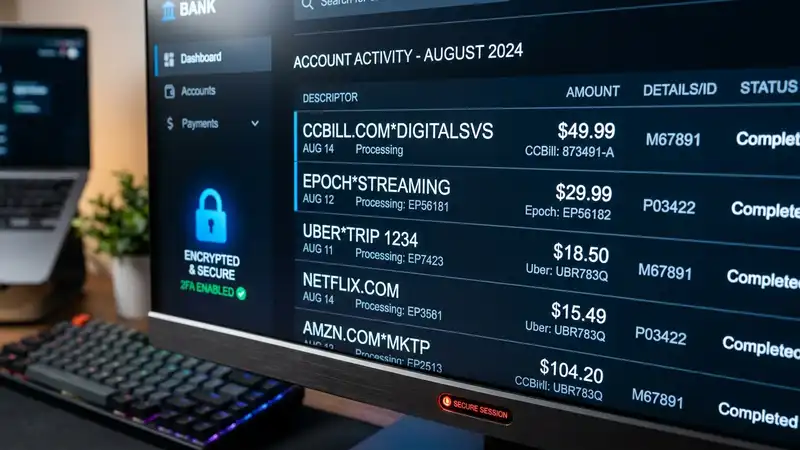
When subscribers purchase premium digital memberships, pay-per-view media, or creator subscriptions, billing privacy represents a primary operational concern. The financial record of a transaction must pass through multiple clearinghouses, card associations, issuing banks, and consumer-facing financial dashboards. The line item appearing on a monthly card statement is neither random nor fully arbitrary; it is governed by strict card network specifications, Merchant Category Codes (MCC), and clearinghouse descriptor mechanics.
Understanding discreet billing requires examining how high-risk payment aggregators interact with Visa and Mastercard clearing networks. This technical analysis breaks down the 22-character merchant descriptor limitation, ISO 18245 category mapping, fintech enrichment heuristics, and tokenized isolation methods designed to maintain absolute statement privacy.
The 22-Character Descriptor Rule in Card Clearing Networks
Credit card processing relies on legacy interchange formats established during early electronic banking standards. When an acquiring bank submits a clearing record through Visa Base II or Mastercard IPM (Integrated Processing Network), the merchant identifier field is strictly bounded.
Clearing Record Payload Specifications
The merchant description record is constrained by the ISO 8583 financial transaction message format:
- Field 43 (Card Acceptor Name/Location): This field accommodates a maximum string length of 40 characters in standard clearing drafts, but standard domestic statement displays restrict the merchant name subfield to exactly 22 alphanumeric characters.
- Character 1 to 22: Reserved for the Merchant DBA (Doing Business As) identifier, gateway prefix, or customer service contact URL/phone.
- Trailing Characters (City/State/Zip): Characters 23 through 38 typically transmit city and state abbreviation (e.g., “CARLSBAD CA”), followed by country code.
Static vs Dynamic Merchant Descriptors
Payment aggregators and direct high-risk merchants utilize two primary technical mechanisms to populate Field 43:
- Static Descriptors: The merchant name remains identical across every transaction processed through the merchant account (MID). The text is hardcoded at the payment gateway configuration level (for instance,
CCBILL.COM*DIGITAL). Regardless of whether a customer purchases an anime subscription or an adult cam token, the identical static text appears. - Dynamic Descriptors: Modern payment gateways utilize dynamic descriptor APIs to alter the statement text per transaction. The acquiring bank allows the merchant to append a dynamic suffix after an asterisk or forward slash (e.g.,
EP*CREATORNAMEorSP*MEDIASTREAM). This enables multi-brand platforms to isolate separate creator accounts while sharing an underlying banking relationship. However, high-risk platforms intentionally configure dynamic descriptors to omit explicit adult keywords to minimize subscriber chargebacks.
Major High-Risk Processors: Statement Formats and Lookup Protocols
Adult content subscriptions rarely display the consumer-facing website domain on financial statements. Instead, charges are billed under the corporate entities or billing domains of specialized Payment Service Providers (PSPs). The three dominant processors utilize standardized statement naming conventions:
| Billing Processor | Typical Statement Descriptor | Length (Chars) | Lookup Portal & Telemetry |
|---|---|---|---|
| CCBill | CCBILL.COM*DIGITALSVSCCBL*873491-A |
21 14 |
Portal: support.ccbill.comDirect 24/7 Phone: 1-888-596-9279 Provides transaction lookup by email + last 4 card digits. |
| Epoch | EPOCH*STREAMINGEP*PAYMENTS8003254115 |
15 21 |
Portal: epoch.com/billingsupportPhone: 1-800-897-5228 Online billing query matches card expiration and surname. |
| Segpay | SEGPAY.COM*BILLINGSP*ONLINEENTERTNMT |
18 19 |
Portal: segpay.com/consumersConsumer assistance: 1-866-450-4000 Instant transaction identification via first-6/last-4 card digits. |
| OnlyFans (Fenix) | Fenix Internet LLCOnlyFans*London |
18 15 |
Managed via Fenix Internet merchant IDs; may include local banking city (e.g., London UK). |
| Fansly (Select Media) | Select Media LLCSM*DIGITALMEMBERSHIP |
16 20 |
Processed through Select Media corporate MIDs with discreet neutral descriptors. |
ISO 18245 Merchant Category Codes (MCC) and Regulatory Classification
Beyond the alphanumeric text string displayed in Field 43, every payment transaction carries a numeric 4-digit classification known as the Merchant Category Code (MCC), defined by ISO 18245. While descriptor text may be neutral, the MCC transmits the core classification of the merchant to the cardholder’s issuing bank.
Primary Industry Codes
- MCC 5967 (Direct Marketing – Inbound Teleservices / Adult Content): The official high-risk code assigned to adult digital entertainment, phone services, and adult video-on-demand. Transactions categorized under MCC 5967 encounter heightened fraud scoring, elevated interchange fees (typically 3.0% to 5.5% plus $0.30 per authorization), and mandatory 3D-Secure 2.0 fraud authentication triggers.
- MCC 7273 (Dating and Escort Services): Frequently assigned to mainstream dating platforms, social discovery networks, and connection apps. While mainstream apps like Tinder or Bumble operate under this code, issuing bank algorithms flag repeated small micro-transactions under MCC 7273 for compliance review.
- MCC 5815 (Digital Goods – Books, Movies, Music): Applied to general digital streaming media, educational courses, and creative software. Mainstream creator platforms strive to qualify for MCC 5815 or MCC 7399 (Business Services Not Elsewhere Classified) to avoid high-risk card association fines and processor reserves.
Fintech Enrichment: Algorithmic Tagging in Modern Banking Apps
Historically, a discreet descriptor on a paper statement provided complete privacy. Modern consumer banking apps (such as Monzo, Revolut, Chime, Chase Mobile, and budgeting tools powered by Plaid or Yodlee) bypass raw Field 43 strings through automated transaction enrichment pipelines.
// Example: Open Banking Enrichment Normalization Rule
{
  "raw_statement_line": "CCBILL.COM*DIGITALSVS 888-5969279 FL",
  "enrichment_engine": "Plaid / MX Transaction Cleanse",
  "parsed_merchant": {
    "normalized_name": "CCBill Payment Gateway",
    "parent_entity": "CWIE LLC",
    "primary_category": "Financial Services",
    "sub_category": "Adult & High-Risk Digital Media Billing",
    "logo_url": "https://assets.bankenrich.com/logos/ccbill.svg",
    "confidence_score": 0.982
  }
}
Mechanics of Banking App Scraping
- String Normalization: The bank enrichment engine strips whitespace, telephone numbers, and clearing suffixes from raw descriptors.
- Co-Location Matching: Machine learning algorithms correlate the transaction time, precise dollar amounts ($9.99, $14.99, $19.99), and processor MIDs against known platform pricing tables.
- Merchant Database Tagging: Even if a charge reads “DIGITAL SERVICES”, an enriched banking dashboard might automatically assign an “Adult Entertainment” or “Dating” icon based on collective community reporting or database classification.
Technical Privacy Mitigations: Tokenized Wallets and Virtual Cards
To prevent exposure through descriptor leaks or banking app categorization engines, security-conscious consumers deploy technological isolation barriers between their primary checking account and the billing endpoint.
1. Tokenized Mobile Wallets (Apple Pay / Google Pay)
When an adult platform supports Apple Pay or Google Pay, the underlying card number is never transmitted to the merchant. The Secure Element creates a Device Account Number (DPAN) and cryptographic cryptogram. However, subscribers must understand the limitations of mobile wallet tokenization:
- Descriptor Transmission: Apple Pay does not alter the merchant descriptor. The issuing bank still receives Field 43 directly from the acquiring gateway.
- In-App Wallet Display: The Apple Wallet or Google Wallet app creates a local log showing the merchant name provided in the payment sheet. If someone accesses your unlocked device, the transaction history is visible within the Wallet application.
2. Disposable and Merchant-Locked Virtual Cards
Virtual debit card providers (such as Privacy.com or Revolut Disposable Cards) provide the highest degree of structural privacy against statement exposure.
// Privacy Architecture: Virtual Card Statement Isolation
[Primary Bank Account]
        │
        ▼ (Single ACH Transfer: "PRIVACY.COM*MONTHLYTRANSFER" / MCC 6012)
[Virtual Card Gateway]
        │
        ▼ (Card Token Issued with Custom Descriptor Alias)
[High-Risk Processor: CCBill / Epoch / Segpay]
By routing the transaction through a virtual card provider, the user’s primary bank statement displays only a neutral transfer to the virtual card operator (e.g., PRIVACY.COM DEBIT or REVOLUT PAYMENT under MCC 6012 Financial Institutions). The high-risk descriptor, MCC 5967 code, and platform details remain contained within the virtual card management dashboard, completely isolated from joint bank accounts, family financial tracking apps, and primary credit statements.
Summary Verification Checklist for Discreet Billing
Prior to completing a transaction on any adult content or creator platform, verify these technical parameters:
- Inspect the Checkout Footer: Review the payment screen for the explicit disclaimer: “Charges will appear on your statement as [Descriptor]”. High-risk compliance rules require this pre-transaction disclosure.
- Verify Processor Identity: Identify whether the payment handler is CCBill, Epoch, Segpay, Verotel, or direct merchant billing. Bookmark the processor’s consumer support portal for immediate transaction review.
- Audit Joint Account Connectivity: Never execute high-risk digital entertainment transactions on credit cards connected to shared household budgeting apps (Mint, Copilot, Monarch, YNAB) without virtual card masking.